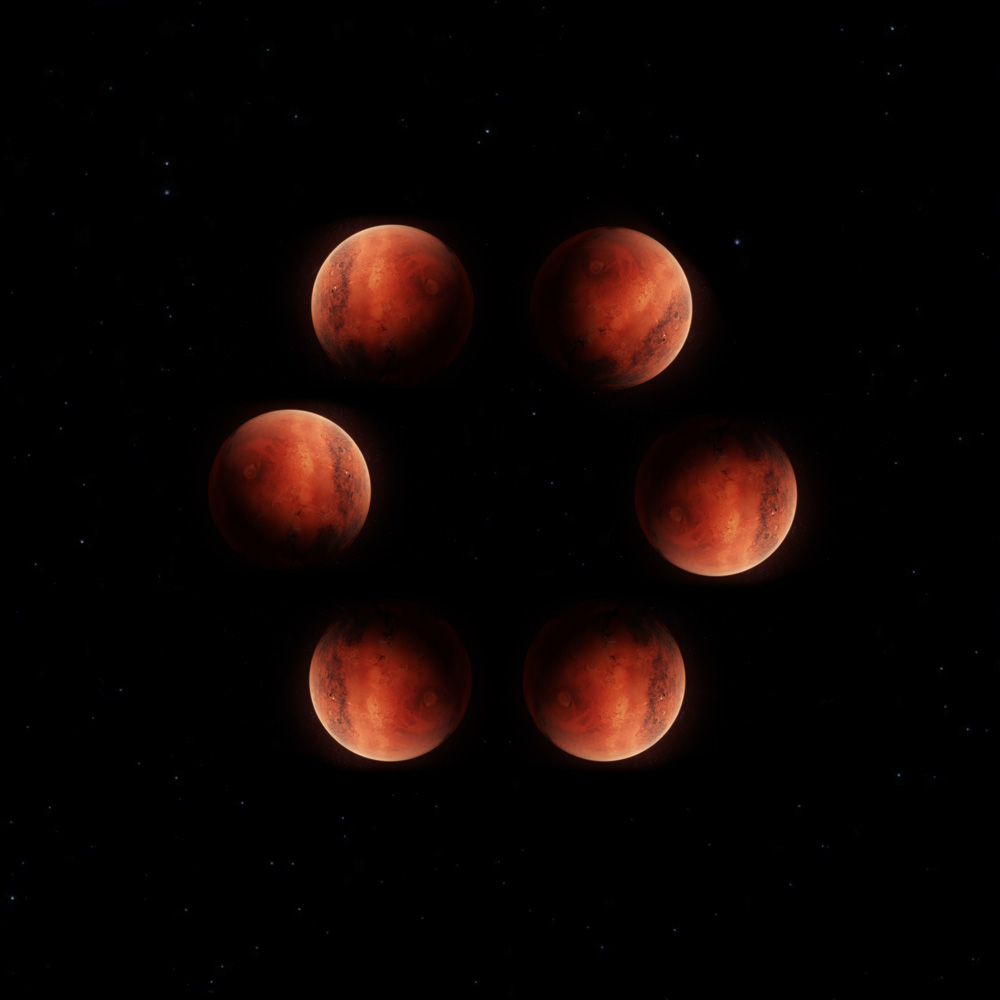

In 2046, humanity reached Mars on a Friday
After nine months crossing the darkness, six people landed on the red planet at 2:32 PM, Greenwich Mean Time. The broadcast was watched by nearly half of Earth’s population.
A historic phrase was expected for that moment.
Teams had been working on it for years. Poets, scientists, communications strategists, philosophers, linguists, historians, screenwriters. The first phrase on Mars had to be worthy of the species’ achievement — meant to belong in books, in school murals, in monuments, in the archives of future colonies.
The first person to step on Mars was a 32-year-old woman named Antônia Miran. The daughter of a Brazilian astrobiologist and a Cape Verdean poet, she grew up between Recife and Lisbon without ever fully belonging to either place. She trained at a space center in the Atacama and then spent a year at a Lunar base, where she learned what true silence feels like before knowing what she would find on Mars.
For eight years, robots had landed before the humans to prepare the impossible. They excavated the soil, printed modules, assembled antennas, buried reservoirs, tested oxygen systems, and cultivated the first algae in sealed chambers. By the time the crew arrived, Mars already had a small habitable scar — shelter enough for six people to endure a year and a half of research, waiting, and solitude before the return window.
When the hatch opened, Antônia descended slowly. The dust rose. The horizon was low, mineral, with nothing that could be called welcoming. An ancient desert, without trees, without creatures, without water in sight. There was a cold and violent beauty there.
Antônia stood in silence for a few seconds.
On the other side, on Earth, billions of people were waiting for the prepared phrase. The one that began with “in the name of humanity.” The one that spoke of courage, destiny, frontier, future. The phrase approved by committees and translated into dozens of languages.
She breathed. She looked at the red ground. Then at the nearly black sky. Then at the blue dot that at that moment was not visible from where she stood, but that she knew was there.
And she said something else.
“Good heavens! Our home is a rare and blue jewel. What did we come here to find that we have not yet learned to love back there?”
There was a delay of several minutes before the phrase reached everyone. At first it seemed like a protocol failure. Then came some awkwardness. And then, gradually — and this took longer — something people did not quite know how to name.
The most anticipated achievement of the century had just produced a question. It was not a question against science, against Mars, or against the future. Perhaps that is why it cut so deep. Antônia was not refusing the feat. She was returning it to its true size.
Humanity had spent decades, fortunes, minds, and lives to reach a sterile planet. And upon arriving there, the first person to step on Mars looked at that desert and felt an instant longing for Earth.
The phrase fell upon young people like a heavy rain after a long, suffocating drought. Twenty years earlier, the youth had already been described as the generation of no desire. They did not want to work like their parents. They did not want to consume like their grandparents. They were called fragile, anxious, scattered, unproductive. But perhaps they were simply intoxicated by desires that were not truly theirs.
Humanity had grown accustomed to calling people consumers. The word seemed neutral. It was not. To call someone a consumer is to reduce their presence in the world to the ability to choose, buy, use, and discard. It is to look at a group of people and see a target audience.
After Antônia’s phrase, that word — which for so long had reduced us to termites devouring whatever lay around — suddenly aged.
They no longer wanted to be consumers. They wanted to be savourers.
The difference seemed too small for anyone used to spreadsheets. To consume was to transform the world into a resource. To savour was to perceive it as wealth.
Between 2046 and 2051, around 1.8 billion young people changed their lives. There were no leaders, no political movement. There was a phrase on Mars and a perception too simple to be domesticated: if our home is a blue jewel, a creative extravagance of cosmic evolution, why do we settle for so little? Why do we submit to so many manufactured truths that keep us from experiencing it at its full power?
The idea of patrimony began to lose its moral shine. For centuries, adult life had been measured by the ability to accumulate — and the list of what became patrimony kept growing until it included time, attention, reputation: things that should have no owner. Young people simply stopped using that measure.
There was no greater heritage than having seen the world with an awakened body. Than knowing the smell of rain in another hemisphere. Than learning a song in a language one does not master. Than entering a house knowing it belongs also to the next stranger who will arrive tired.
Houses changed their function. They stopped being biographical safes and became stations of permanence — some for three days, others for winter, for healing, for learning, for farewell. Each with simple rules: use, care, repair, leave better.
Clothing changed too. A jacket could cross twenty countries. The brands that survived were those that learned to design objects capable of lasting many lives without needing to belong to just one. The backpack became the new wardrobe. Repair became signature. Care became status.
Mobility stopped being a promise to escape traffic. Solar trains, autonomous boats, community eVTOLs, walking routes — a circulation that resembled something alive more than a transportation system. Travel gained new meanings. It became synonymous with living, with all the discomfort that implies, and the delay in knowing what one has learned.
Later, some biologists would say that the movement was not an invention, but a memory. Salmon are born in rivers, cross oceans, and return. Whales traverse hemispheres. Monarch butterflies cross continents as if carrying a map in the wind, which is technically what they do. Life was never as sedentary as civilization led us to believe. To migrate, to circulate, to return: many species had been practicing this for millions of years.
The word that emerged to describe these young people was “terrantes.” They were not digital nomads trapped in screens in beautiful places. They were nomads of experience, young people who did not travel to escape the Earth, but to belong to it entirely.
Schools were slow to understand. Companies were slower. Some tried to capture the movement with premium nomad life packages, assisted detachment, freedom by subscription. They created roles for young people who never showed up at the office but sent reports from deserts, ports, forests, collective kitchens. It was useless. You cannot domesticate with corporate benefits a movement born from a question asked on Mars at 2:32 PM on a Friday.
They did not want casual Friday. They wanted the Friday on which Mars gave us back the Earth.
Technology, curiously, did not stop the movement. Sensory holographic presences, popularized in the late 2030s, allowed scattered families to keep meeting with an intensity difficult to explain to anyone born earlier. It was not an improved video call. There was texture, temperature, smell, micro-touch. A mother in Manaus could feel her son’s hand in Kyoto. A grandfather in Lagos could cook with his granddaughter in Valparaíso and recognize the smell of coriander burning in the pan. Distance continued to exist, but it no longer held the same power over guilt.
Families did not end. They became more elastic. Some suffered. Some broke. Some discovered a less territorial love.
Not everyone left.
That was the least anticipated part. Nomadism produced not only travelers; it produced guardians. Young people who chose to stay to care for languages, rivers, festivals, seeds, archives, recipes, accents, forests, the customs of asking permission before entering a forest. Those who left needed those who stayed. Those who stayed needed those who left.
Gradually, the question “what do you do?” lost its centrality. In its place came harder questions: where have you been, what have you learned to care for, which place changed the way you breathe, what was the last thing you returned better than you received.
In 2051, five years after the arrival on Mars, economists were still trying to measure the phenomenon with old categories: a drop in durable goods consumption, contraction of the young real estate market, a talent retention crisis, expansion of shared-use networks. The words were accurate and too small for what was happening, which was less a trend than an exchange of mythologies.
For a long time, the dominant myth said that a successful life was one that turned time into money, money into patrimony, and patrimony into security. Generation Omega was building another myth: a successful life was one that turned time into presence, presence into connection, connection into lived experience. It was not a manifesto. It was a new practice — messy, irregular, at times contradictory, like every practice worth something.
Antônia Miran returned from Mars after two years. She found a planet different from the one she had left. Not richer, not more peaceful, and not simpler. Perhaps even more confused. But there was a new vibration in the stations, in the ports, in the workshops, in young bodies that vibrated without apologizing for not wanting to win at life.
She was asked many times whether she regretted the improvised phrase. She always replied that she did not quite remember choosing those words. That they had passed through her. That in that moment she was looking at the red ground and thinking, for some reason, of a street in Lisbon that smelled of bread.
In an interview recorded at a permanence house on the coast of Pernambuco, Antônia said that Mars had been the greatest experience of solitude in human history. And that perhaps it was necessary to step on a dead planet to understand the miracle of a hummingbird, of a crystal-clear waterfall, of the wind scattering the seeds of a dandelion, or the taste of a ripe mango.
Then she fell silent for a few seconds.
Outside, young people were arriving from various places. They left their backpacks on the porch, washed their feet, hung clothes worn by many landscapes. Someone was making a bolo de rolo in the kitchen.
Someone was mending a sandal. Someone was teaching a child to say thank you in a nearly vanished language.
Antônia looked at them and smiled.
Mars was still there, red, magnificent, barren, turning in its mineral solitude.
Earth was not.
Earth continued here — blue, loud, damp, imperfect, smelling of ripe fruit, sea salt, smoke, mud, sweat, jasmine, animal, coffee, rain coming.
Perhaps the greatest space achievement of the 21st century was not reaching another planet.
Perhaps it was, finally, returning to this one.
Heading 1
Heading 2
Heading 3
Heading 4
Heading 5
Heading 6
Lorem ipsum dolor sit amet, consectetur adipiscing elit, sed do eiusmod tempor incididunt ut labore et dolore magna aliqua. Ut enim ad minim veniam, quis nostrud exercitation ullamco laboris nisi ut aliquip ex ea commodo consequat. Duis aute irure dolor in reprehenderit in voluptate velit esse cillum dolore eu fugiat nulla pariatur.
Block quote
Ordered list
- Item 1
- Item 2
- Item 3
Unordered list
- Item A
- Item B
- Item C
Bold text
Emphasis
Superscript
Subscript
Texto:
Fred Gelli
Comunicação&Mkt&Marca Tátil:
Luiza Magalhães, Marcelo Cândido e Bruno Cesar
Assessoria:
Flávia Nakamura