
The meteor, the buffoon and my first chinese car
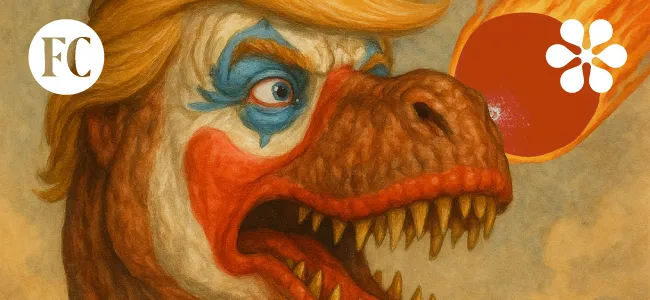
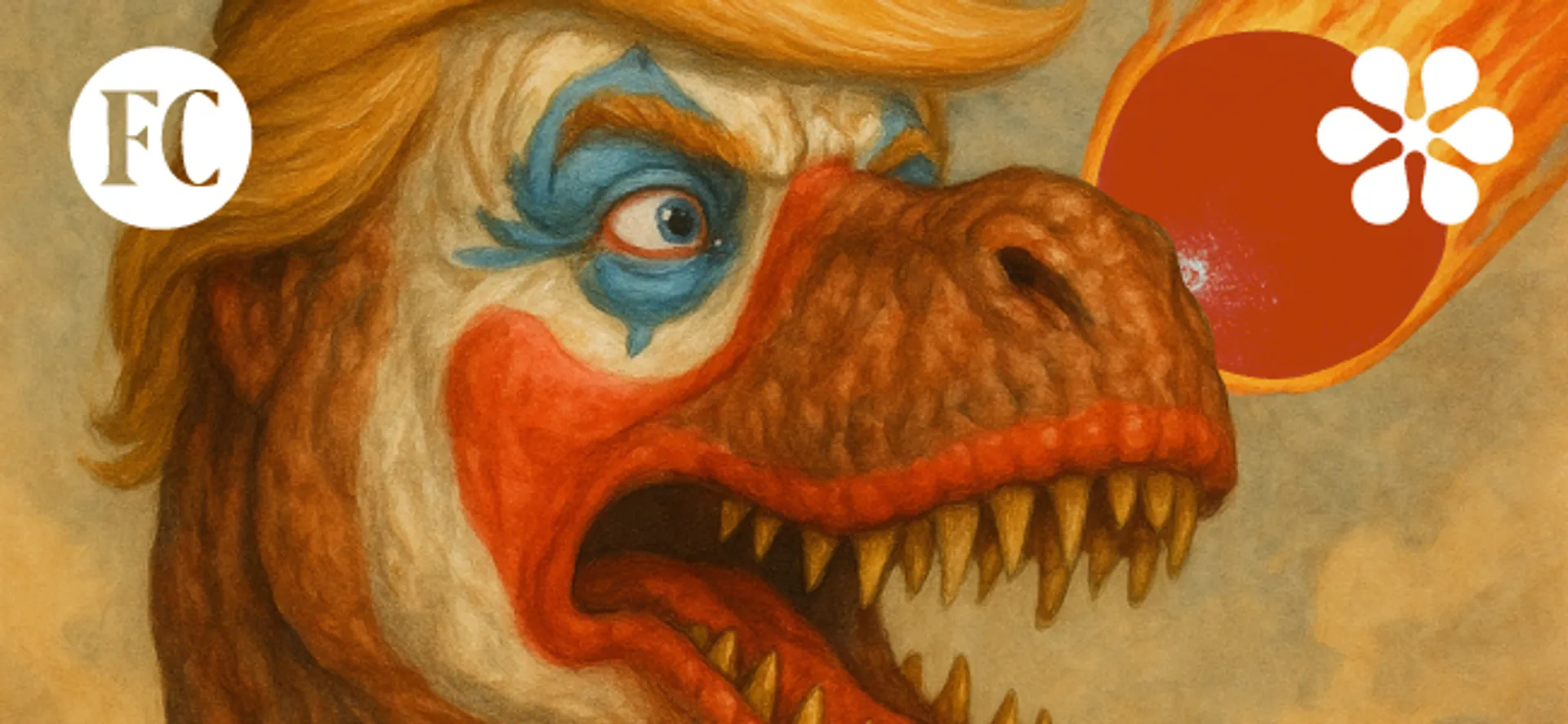
If there’s one lesson nature has taught me, having been my main source of inspiration for so long, it’s that in evolution no game is permanently won. You can have the strength and size of a Tyrannosaurus rex, carry a track record of dominating the planet for more than 150 million years, yet overnight everything can change. To become extinct, to lose relevance, is in fact the inexorable fate of everything in the universe. Entropy, collapse, make room for the new. Not even the stars escape. Sometimes the end is pure chance—like the Everest-sized meteor that hit the Gulf of Mexico and gave the dinosaurs no chance—but, very often, it’s more whimsical and counts on the active help of the very candidate for extinction. Arrogance, shortsightedness, or unbridled success can directly trigger the decline of people, companies, or empires. History is full of examples. And, even so, we keep stumbling over the same stones.
After 35 years working with branding and design, we’ve watched many brands face the challenge of renewing their relevance. The degree of transformation required varies according to the size of the gap and how long these organizations take to react. I often say there is no heavier evolutionary anchor than success itself. Brands that have shone for a long time tend to resist the changes needed to stay alive—and, sometimes, it’s too late. The startup meteor, with little to lose, is merciless. Others get lost trying to imitate competitors, abandon their nature, and don’t get far. Now, I have seldom seen suicidal brands—those that, all of a sudden, begin to deny everything they have built over decades: values, purposes, visions. And the result?
Just follow global news to understand what is happening to the American empire. How is it possible that one of the world’s most powerful brands—the USA brand—is being treated so badly? It all starts with the CEO. Donald Trump is the perfect caricature to embody American decline. The level of bizarreness and irrationality seems endless—as does the political and ideological appropriation of the public machine for the crazy (and cruel) whims of the orange man, leaving even some of his strongest supporters in shock. It’s true that many of his ideas and values have always been part of the DNA of a relevant slice of American society. But now, as in many places around the world, Pandora’s box has been opened—and the monsters are loose.
The American Dream—of opportunity for all, of diversity, of freedom, of democracy as the world’s beacon—has turned into a nightmare, especially for the millions of immigrants who helped build the country.
And what about democracy?
I think it’s time we reassessed its true meaning. Journalist Bruno Torturra says it has now become capitalism’s “nom de guerre.” Multibillionaires no longer need to disguise the extent of their influence over politics and state decisions. What is better for the few outweighs what would be better for all. And the most impressive thing: where is the opposition? The Democratic Party and much of society seem paralyzed in the face of the collapse of everything that still sustained global trust in the country—which, according to recent polls, is already eroding the USA brand’s image around the world.
But evolution is relentless and leaves no empty space. When one species declines, others advance. And that is exactly China’s position in today’s planetary ecosystem. It has been working hard, with the discipline and strategic vision that a 5,000-year-old culture provides. Not even China’s most optimistic leaders could have imagined that the adversary would make it so easy, scoring so many own goals. That does not diminish the effectiveness of China’s moves in every field of human knowledge.
Absolute leadership in number of PhD graduates. Technological vanguard. An unprecedented income transfer that has formed a middle class of 800 million people. And perhaps the most surprising: it has begun to occupy another space, far beyond geopolitics or the economy—a place in people’s minds and even their hearts.
In mine, it certainly does. First, for being the only nation with the appetite and capacity to withstand the buffoon’s bluster. Second, because I have been feeling, firsthand, the concrete effects of the branding investments China has been making. And a brand, after all, is the coherence between storytelling and store-doing. And they have been delivering.
From factory of the world, a symbol of cheap trinkets and exploited labor, China has become a global reference on almost every front: from AIs to sustainability (yes, it is today the only nation that takes the Paris Agreement seriously and invests heavily in climate change); from space exploration to the greatest innovations in medicine.
But it is in storytelling that the biggest surprises come. The tagline “Welcome to the real world,” used by hundreds of Chinese influencers on TikTok, has become a slap in the face—especially for Americans—about the USA brand’s decline. One of the most viral videos shows a Chinese man speaking perfect English, in a Pinterest-ready setting, challenging the U.S. to carry out an internal revolution to stem the decay. He recalls that, for decades, the relationship with China generated wealth for both sides—but while there the money was invested in education, health, mobility, and modern cities, in the U.S. it became yachts, private jets, and absurdly concentrated wealth.
He calls Americans consumption addicts—and ever poorer. Worst of all: the cap seems to fit.
Of course, China has problems—and many we can’t even access, due to censorship and lack of freedom. But when students are arrested inside American universities for protesting civilian massacres sponsored by an aspiring dictator, what freedom are we talking about?
Oh, but in China you can’t use WhatsApp or watch YouTube.” So freedom is being able to hand over your data to American big techs that shape the course of history?
“Welcome to the real world.”
That invitation is echoing around the world. Besides revealing a surprising China—far from clichés—it also lays bare the contrast with Western toxic propaganda and fake news. Now, the Chinese really seem to be giving their own people more space to show the country from the inside. Hundreds of videos display the new meanings of “Made in China”: incredible (and kitschy) cities, starred restaurants, traditional farming communities, technologies, innovation—all in a TikTok scroll.
And it was in this context that, wanting to buy a new car—one that would take me as close as possible to nature, along trails and back roads—I ended up, to my own surprise, choosing a Chinese car.
And the decision wasn’t just because the car is amazing, or because it cost almost half the price of the Jeep I had my eye on.
It was exactly because it wasn’t American.
It was Chinese.
Heading 1
Heading 2
Heading 3
Heading 4
Heading 5
Heading 6
Lorem ipsum dolor sit amet, consectetur adipiscing elit, sed do eiusmod tempor incididunt ut labore et dolore magna aliqua. Ut enim ad minim veniam, quis nostrud exercitation ullamco laboris nisi ut aliquip ex ea commodo consequat. Duis aute irure dolor in reprehenderit in voluptate velit esse cillum dolore eu fugiat nulla pariatur.
Block quote
Ordered list
- Item 1
- Item 2
- Item 3
Unordered list
- Item A
- Item B
- Item C
Bold text
Emphasis
Superscript
Subscript
Text:
Fred Gelli
Communication & Mkt & Marca Tátil:
Luiza Magalhães, Marcelo Cândido and Natália Silveira
Public Relations:
Flávia Nakamura