The heart knows no limits
Regardless of any limitations your body may have, if your heart truly wants it, you’ll get there.
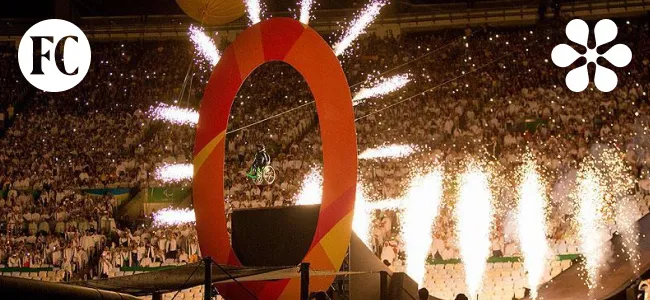
On September 7, 2016, at eight in the evening, the countdown began: 10, 9, 8, 7, 6, 5, 4, 3, 2, 1, 0. At that very moment, American athlete Aaron Wheelz “dropped” down a 30-meter mega skate ramp, constructed under the supervision of Bob Burnquist, and leaped through a giant zero, performing a flawless somersault and landing on the other side to the delight and surprise of the 60,000 spectators that packed Maracanã on that historic night.
The first message was clear: do not pity these guys! They are incredible athletes who fight for every split second in a competition, who will do almost the impossible for the chance to stand on a podium representing their home countries.
Thus began the opening ceremony of the Rio 2016 Paralympic Games. It was the result of the efforts of a super team of over 500 people, including some of the best professionals in the world, who spared no effort to make it unforgettable.
The responsibility was even greater because of the success of the Olympic opening that captivated the world just over a month earlier. The mission to conceive it in its entirety was given to us: to me, Vik (Muniz), and Marcelo (Rubens Paiva).
All of this came together under the brave and light-hearted production of our dear and late Flávio Machado. It took two and a half years of intense work, extensive research, and many, many lessons!
For example, hearing from Marcelo himself that this story of overcoming obstacles was nonsense, as he and many other people with disabilities did not feel like they were overcoming anything. They lived their lives with the challenges and pleasures that we all have. Seeing Marcelo playing with his children who would hitch a ride on his electric wheelchair through winding paths only confirmed this perspective.
Many of our certainties and beliefs were being dismantled with each meeting with athletes and former athletes who showed us how easy it was to be mistaken even with the best intentions.
Hearing from a top athlete that at that moment, after the accident that took both his legs, he was much happier because he had finally found a purpose in his life helped us see what that ceremony should truly celebrate.
Regardless of the configuration of your body, of your mobility and sensory limitations, it is truly the heart that matters. Because it knows no limits! It is what makes us equal in our truly human condition.
And it was in this challenge — unlike the Olympic identity, which depicts bodies holding hands in a great embrace evoking unity and celebration — that we understood this was not about bodies.
The Paralympic brand needed to convey the boundless energy these athletes have, moving from the depths of despair when they might lose part of their bodies, to the heights of the podium.
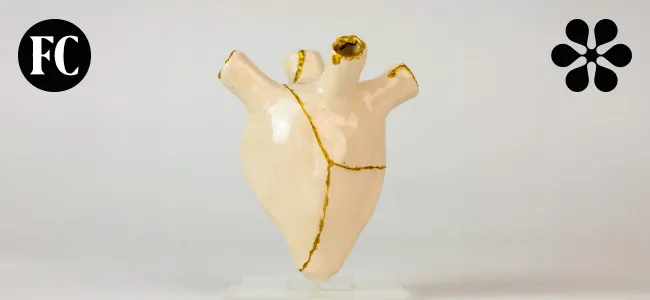
This was the journey we wanted to represent. The archetypes of the heart and the infinity symbol were our inspiration to convey the power of this motivation. And more than that.
The Paralympic brand, just like the Olympic one which had already been three-dimensional, now needed to be multisensory as well, so that everyone, regardless of their bodily characteristics, could interact with the identity that represented them.
It pulsed with light and vibration, reacting to people’s proximity. When touched, it resonated with a sound that mixed the heartbeat with the sounds of a cheering crowd. It’s hard to explain, but you can see it in the video below, and it worked in a unique way.
One of the most emotional moments was when Ádria Santos, one of our greatest Paralympic medalists, on the day of the launch, with dozens of photographers and journalists in front of her, approached the brand — nothing had been planned — and began to interact with it, feeling the sound, the heartbeat pulse.
She couldn’t contain her emotion and started to cry, saying it was the first time in her 20-year career as a blind Paralympic athlete that she could finally interact with the brand that represented her.
Of course, no one could hold back the tears, from Andrew Parsons, the president of the Brazilian Paralympic Committee at the time, to the assistant holding the microphone during the interview.
And this was the universe of creative possibilities opened up to us in the conception of the ceremony on September 7, 2016. How to translate that infinite energy, the resilience of those athletes, a space that challenged our common sense and inspired us to find the poetic and plastic strength and symbolism of what we would see during the games that would start the next day?
In addition to the classic parade of athletes that culminates in the assembly of a giant puzzle with the photo of all of them in the middle of Maracanã, we also had 13 segments that gradually told the story we had imagined.
From Amy Purdy, the American bi-amputee snowboarder — who, after intense samba lessons with Alice Gelli, my daughter and creative assistant for the entire project, danced with a giant robot, showing the relationship between technology and the human — to the choreography of two blind dancers whose movements were mapped into giant tactile images.
From the choreography of large sails stubbornly sailing against the wind with the mission of forming the “agitos” to the moment when Maracanã turned into a giant heart, pulsating with light and the sound of clapping and stomping feet of thousands of people.
But it was in the unexpected that the magic truly happened. Near the moment of lighting the Paralympic cauldron in Maracanã, athlete Márcia Malsar was running with difficulty due to the aftereffects of her cerebral palsy.
The rain started to fall, and as she held the lit torch, she lost her balance and fell. A profound silence ensued. Two people from the production approached to help her. One took the torch, which remained lit.
We, in the control booth, looked at each other anxiously, as everything could end there if she had been injured. But then she gave a thumbs up to the young people who were helping her, took the torch again, and started running. At that moment, the Maraca erupted with applause, cheers, and whistles celebrating her courage.
Well, I don’t need to say that this was the most emotional moment of my entire professional journey. Tears were streaming horizontally, and at that moment, I looked at Vik, Marcelo, and Paula Melo, our super creative leader, essential throughout the process, and all in tears, we realized that after all this time of the project, all the investment in scenery, costumes, and equipment, it was in that unique, unthinkable moment, in what could have been the accident that ruined everything, that our concept materialized in the clearest and most powerful way.
In front of an incredulous Maracanã, Márcia Malsar made the strength of her heart matter, to carry, even with her fragile body, the Paralympic flame to the cauldron.
The heart truly knows no limits. Regardless of any limitations your body may have, if your heart truly wants it, you can make it happen! Here’s to the Paris 2024 Paralympic Games, once again showing us that only the strength of the heart can truly change the world!
Heading 1
Heading 2
Heading 3
Heading 4
Heading 5
Heading 6
Lorem ipsum dolor sit amet, consectetur adipiscing elit, sed do eiusmod tempor incididunt ut labore et dolore magna aliqua. Ut enim ad minim veniam, quis nostrud exercitation ullamco laboris nisi ut aliquip ex ea commodo consequat. Duis aute irure dolor in reprehenderit in voluptate velit esse cillum dolore eu fugiat nulla pariatur.
Block quote
Ordered list
- Item 1
- Item 2
- Item 3
Unordered list
- Item A
- Item B
- Item C
Bold text
Emphasis
Superscript
Subscript
Text:
Fred Gelli
Communication & Mkt & Brand Tátil:
Luiza Magalhães, Marcelo Cândido and Natália Silveira
Consulting:
Flávia Nakamura