
The Value of True Originality and Creative Instant Noodles
The date was May 19, 1967. The place, Brian Epstein Saville Theatre, in London.
Speculation in the press suggested that something truly new would be presented to the world and had everything to surprise, even the greatest enthusiasts of the most famous band of all time.
“Sergeant Pepper’s Lonely Hearts Club Band” by the Beatles not only fulfilled the promise but is still considered one of the 10 most important albums in the history of music. It won two Grammys, was an instant public success, and influenced not only music but also art, fashion, and culture.
In some way, it can be said that this creative explosion — which featured completely revolutionary recording techniques, instruments never used in pop music such as sitars and tablas, and an iconic cover designed by Jann Haworth and Peter Blake — transformed into a timeless masterpiece and changed the world.
What does an idea need to change the world? What makes people able to metabolize ingredients that are already here — seven musical notes, 118 chemical elements in the periodic table, and a handful of words — in a completely new way? What is truly original, what surprises, shocks, dismantles patterns, breaks rules?
It can be a song, a scientific theory, an artistic manifesto, or a revolution. The fact is that these ideas, when they are truly original, become milestones, forever impacting our way of understanding the past, living the present, and, most importantly, imagining the future. Because from them, new possibilities open up.
What do Albert Einstein, Pablo Picasso, Heitor Villa-Lobos, Marie Curie, Igor Stravinsky, Santos Dumont, Tarsila do Amaral, Mahatma Gandhi, Carolina Maria de Jesus, and Pelé have in common?
It seems that first, they were always more willing to take risks, experimenting more, both technically but also culturally and socially, breaking established rules and paradigms.
At the same time, they seemed to have the ability to catalyze the latent trends of their time. What was already in the air and no one had managed to channel until then. They were not just recombining what had been done before. They were not clinging to the safe spot, to what had already worked. They bet on the new.
But above all, it seems that all of them managed to create something truly original precisely because they had the courage to stay connected to their origins, respecting what was particular to them in their trajectories and drawing from there the inputs to propose the new.
Steve Jobs created Apple’s differentiators based on his life experiences, including being adopted, his trip to India, and his interest in calligraphy. Frida Kahlo, in her revolutionary artistic approach, basically exposed the scars of an intense life, marked by a serious accident in her youth, which made her dive into her interior and share it with the world. None of them was trying to imitate anyone.
They were, indeed, giving vent to their deepest beliefs shaped by their origins, by their limitations, and talents. Probably achieving an extra level of contact with their origin, with what indeed defined them. It seems obvious, but it is not.
It is very common to believe that, in an increasingly competitive world, we will have a better chance of standing out if we follow proven models of success, copying the successful competition, or even denying our origin in the name of idealized references, whether for an individual or a company. This reflection applies to both.
Companies are a group of people who put their core competencies at the service of common goals. They will be more or less original to the extent that they can have absolute clarity about their origins, the reason they exist, and have thrived up to this point.
At this moment, the next move is to seek the re-signification of this origin in light of the new demands of the world. From this encounter arises the space for truly original ideas to emerge.
In English, the word “origin” is contained in “originality.” An overlap that inspires us due to the celebration of Tátil’s 35th anniversary. A branding and design consultancy that was born from my origin as a design student in 1989, absolutely enthusiastic about the idea of nature as a powerful source of inspiration for thinking about innovation. All our effort to put original ideas into the world during this time emerges from this origin and opens space for the reflection I am making now.
The fact is that without truly original ideas and solutions, we will hardly be able to build desirable futures for us as a species and for everything else that exists alive on this incredible planet.
For now, I fear that we are compromising part of our ability to have these fresh and revolutionary ideas as we have outsourced two of the essential competencies that make us a fundamentally creative species: intuition and imagination.
As I have mentioned in other articles, algorithms and, more recently, generative artificial intelligences have been gaining space in the way we decide and create. With this, new generations, especially digital natives, run the risk of having these ancestral competencies atrophied, because the brain, obsessed with economy as it is, understands that what is not being used does not deserve to receive energy.
And worse, right at the moment when they will most need them, as they are inheriting a gigantic hot potato with the inevitable social and climate issues on the horizon, not to mention wars, the systemic crisis of democracy, and capitalism.
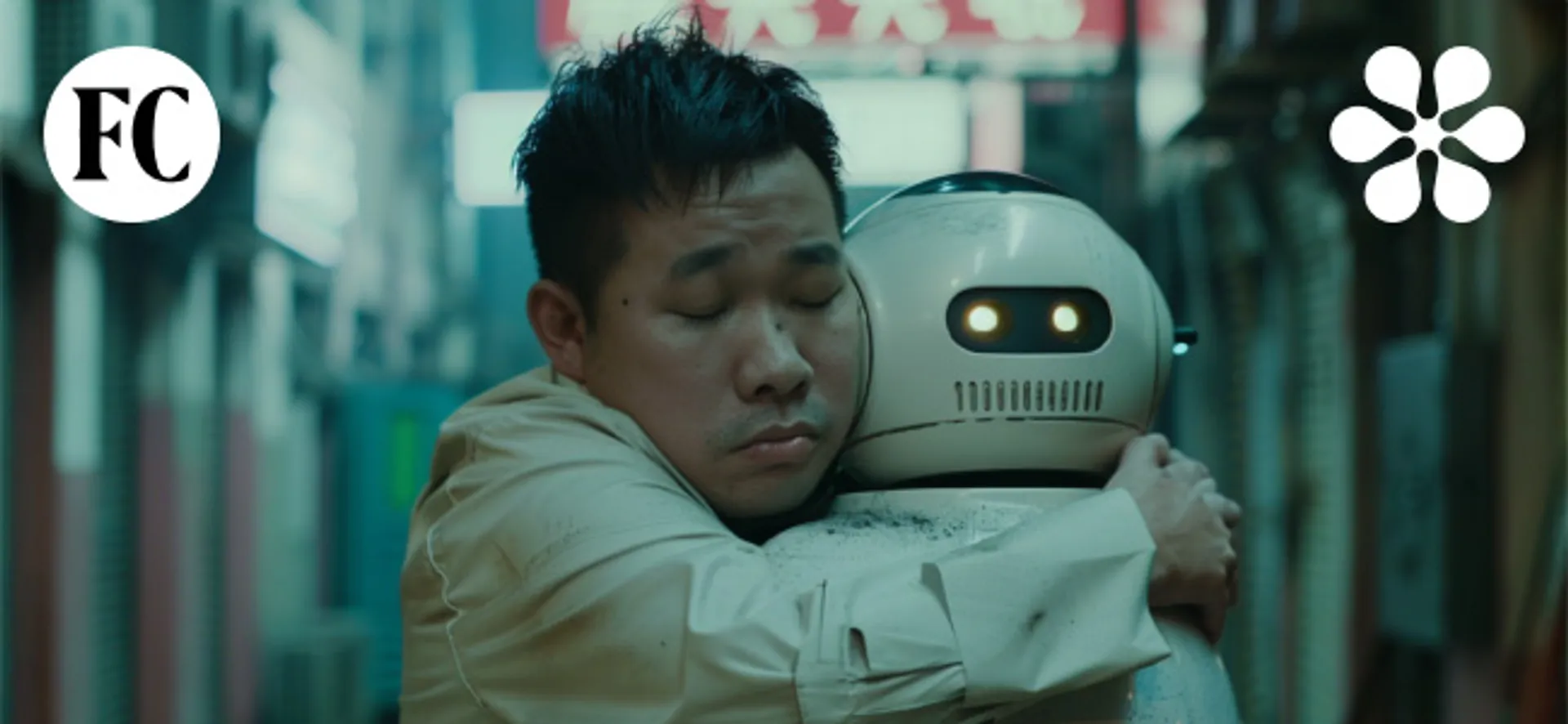
Imagining the new will be practically a pre-condition for our survival. The problem is that it seems we are betting all our chips on artificial intelligences as the Holy Grail of innovation with their instant answers, delivering maximum productivity, and in the creative area, doing in seconds the work that dozens of people would take days.
And therein lies the danger. Everything that AIs offer us, for now, has to do with what they see through the rearview mirror from the ability to metabolize all human production up to this point.
The situation becomes even more complicated when, since in the last 18 months they have practically devoured all available content, they are now starting to feed on their own production, becoming self-referential and, consequently, even more homogeneous in their aesthetics and quite recognizable styles.
This applies to images and videos, but also to texts, in which arguments full of conviction, even if mistaken, simply apologize for the error when confronted and move on to the next challenge.
We run the risk of seeing our cultural, intellectual, and expressive production turn into a large creative instant noodle in its seemingly tasty mediocrity.
Far from me denying the power of artificial intelligences and their role in innovation processes with their infinite capacity to analyze large volumes of data or simulate and model complex scenarios.
My provocation has been that we cannot allow our natural intelligence, the one that brought us here and that, indeed, is responsible for the invention of AI tools, to be emptied of its relevance, at the risk that, without it and its entire sophisticated synapse-based system, we will stop being the controllers to be controlled.
Heading 1
Heading 2
Heading 3
Heading 4
Heading 5
Heading 6
Lorem ipsum dolor sit amet, consectetur adipiscing elit, sed do eiusmod tempor incididunt ut labore et dolore magna aliqua. Ut enim ad minim veniam, quis nostrud exercitation ullamco laboris nisi ut aliquip ex ea commodo consequat. Duis aute irure dolor in reprehenderit in voluptate velit esse cillum dolore eu fugiat nulla pariatur.
Block quote
Ordered list
- Item 1
- Item 2
- Item 3
Unordered list
- Item A
- Item B
- Item C
Bold text
Emphasis
Superscript
Subscript
Text:
Fred Gelli
Communication & Mkt & Brand Tátil:
Luiza Magalhães, Marcelo Cândido and Natália Silveira
Consulting:
Flávia Nakamura